
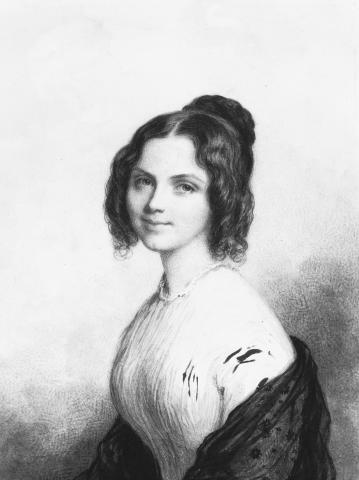
Quick Facts
Born: November 11, 1815
Died: March 23, 1891
Nationality: United States
Genres: Romantic, Reflective, and Devotional Poetry
Works: Handbook of Universal Literature From the Best and Latest Authorities (2011), The Rhode-Island Book: Selections in Prose and Verse, from the Writings of Rhode-Island Citizens (2018)
Anne Charlotte Lynch, also known as Anne Charlotte Botta (November 11, 1815 in Bennington—March 23, 1891 in New York) is an American poet, sculptor, historian of literature and saloon. Its lounge is the main meeting center of the American literary elite of its time. She created the Botta Prize of the French Academy for the best essay on the subject of “The Status of Women.”
At the age of sixteen she was sent to the Albany Female Academy, where she graduated with great distinction in 1834 and remained there as a teacher for a few years. She moved to Providence with her mother in 1838, where she continued to teach. In 1841, she compiled and edited “The Rhode Island Book,” a collection of poems and verses by the best regional writers of the time, including two poems. She also began inviting these writers to her home for her evening receptions. It is said in 1843 that “Providence's best literary society was in Miss Lynch's salon.”
In 1845, Anne met the famous actress Fanny Kemble, of whom she became a close friend and who introduced her to a wider literary circle. That same year, she moved to Manhattan with her mother. She began teaching English composition at the Brooklyn Academy for Young Ladies. She continues to write and is published in periodicals such as The New York Mirror, The Gift, The Diadem, Home Journal, and the Democratic Review. In New York, she continues her literary receptions that she holds every Saturday night. It was at one of these receptions that she introduced the unknown Edgar Allan Poe to the New York literary society and gave him the opportunity to recite his poem “The Raven” for the first time. In 1848, his book Poems was published by George P. Putnam. Edgar Allan Poe said of her: “She is chivalrous, she sacrifices herself, equal to any destiny, capable even of martyrdom, for whatever seems to her a holy cause. She has a hobby, and that's the idea of duty”.
Anne Lynch lived in Washington DC from 1850 to 1853, while serving as Senator Henry Clay's personal secretary. For many years, she was known for her high profile shows at her home on West 37th Street. Unlike other fairs, which served as a means of being seen by New York high society, its receptions offer a creative space in which artists can meet and collaborate. It is said from its salons that no one is neglected or treated as a celebrity, and each one is stimulated, refreshed and happy. At Mrs Botta's receptions every Saturday evening, the participants meet the writers, best-known actors and artists, such as Poe, Margaret Fuller, Ralph Waldo Emerson, Amos Bronson Alcott, Louisa May Alcott, Horace Greeley, Richard Henry Stoddard, Andrew Carnegie, Mary Mapes Dodge, Julia Ward Howe, Charles Butler, Fitz-Greene Halleck, Delia Bacon, Grace Greenwood, Bayard Taylor, William Cullen Bryant, Helen Hunt Jackson, actress Fanny Kemble, Daniel Webster and many others. Her friend Kate Sanborn began her career as a literary speaker at these receptions. During his lecture tour of the United States in 1882, Oscar Wilde attended one of his receptions.
A Boston writer says: “It is not so much what Botta did for literature with her own pen, but what she helped others to do, that will make her name a part of the literary history of the country.”
In 1860 Anne published Handbook of Universal Literature, which contained concise accounts of the authors and their work. She writes: “This work was started many years ago, as a literary exercise, to meet the personal demands of the writer.” This book is used as a manual in many educational institutions. She also encouraged the creation of Barnard College.
She is also a bust sculptor. His marble sculpture by Charles Butler was donated to New York University. She says: “Beauty in art, in my opinion, is not simply about copying nature, but about preserving the true features of the subject, and breathing into them a breath of spiritual life, which should bring them to their ideal form.”
She died of acute pneumonia in 1891 at the age of 76 and was buried at Woodlawn Cemetery in the Bronx.
She refuses to write an autobiography. After her death, her husband collected correspondence, poems, and biographical information to publish a book in 1893, Memoirs of Anne C. L. Botta: Written by Her Friends. Her friend Ms. L. Runkle wrote about her: “Life was the material she worked with.”