
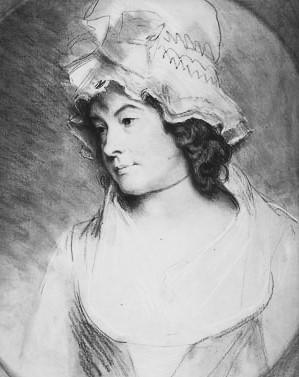
Quick Facts
Born: May 4, 1749
Died: October 28, 1806
Nationality: Great Britain
Genres: Romantism
Works: Elegiac Sonnets (1784), The Emigrants (1793), The Young Philosopher (1798), Conversations Introducing Poetry (1804), Beachy Head and Other Poems (1807)
Charlotte Turner, known as Charlotte Smith (May 4, 1749 – October 28, 1806), was more than a poet and a writer; she was a literary luminary. Her words, like a secret thread woven through time, are said to have inspired the likes of Jane Austen and Charles Dickens, leaving an indelible mark on the world of literature. Her life story is a tale of talent, passion, and the power of words to shape history. As a poet, she was a true pioneer—one of the shining stars who paved the way for the English Romantics, her words a living legacy of the human spirit. Her work as a novelist is a bit more of a mystery—often labeled as a Gothic novelist—but behind the shadows of mystery, she was a passionate observer of the world around her. She was deeply interested in social and political issues, especially the tumultuous events of the French Revolution, which she followed closely like a keen spectator watching history unfold.
She grew up in southern England and was married at 15 to Benjamin Smith, a violent, unfaithful and prodigal man, son of a wealthy merchant. He was soon ruined and in 1783 Charlotte found herself in prison for several months for debt alongside her husband. It was a dark chapter in a young family's story. Like a spark of hope, Charlotte decided to publish some of her poems, a daring move to help support their growing family. It was a story of creativity and determination in the face of hardship. The collection Elegiac Sonnets appeared in 1784 and was an immediate success, a true masterpiece that captured the hearts of readers. Charlotte expresses her thoughts in the form of sonnets, contributing to the rebirth of a form that had disappeared since the mid-17th century. Her poetry, famous for its accents of sadness and melancholy, continues to grow in favor of the public, and became a testament to the power of words and the resilience of art. The Elegiac Sonnets appeared in multiple editions, leaving an indelible mark on the hearts and influenced romantic poets such as William Wordsworth and Samuel Taylor Coleridge.
In 1787 Charlotte Turner Smith, tired of being deceived, tired of a life of betrayal and poverty, separated from her husband. It was the beginning of a new chapter in her story. She starts writing novels to make her family live. She wrote at a remarkable pace: Emmeline or the Orpheline of the castle appeared in 1788, Ethelinde or the Recluse of the lake in 1789, then followed Célestine or the Victim of prejudice (1791), Desmond or the philanthropic lover (1792) and The Old Cousin's Testament (The Old Manor House), 1793), her best-known work. Some of her works are hailed by Walter Scott or Jane Austen.
An early admirer of the French Revolution, Smith enjoyed Mary Wollstonecraft, the author of "A Vindication of the Rights of Woman". According to Wollstonecraft's husband, William Godwin, Charlotte Smith's salon became the meeting place and a vibrant hub for radical intellectuals in the 1790s—a true haven for ideas and revolution. Charlotte Smith soon followed them in their criticism and joined the chorus of all those who dared to challenge the oppressive grip of Jacobin authoritarianism. A poem in free verse, The Emigrants (1791), describes the situation of the emigrant clergy and nobility who found refuge in the countryside of Sussex. Like a heroine of her own story, having been forced into exile to escape her husband's creditors, Smith understood their plight like no one else—her heart open to their fragile existence, she was sensitive to their precarious situation. Without hiding the injustices that emigrants once committed against the poor, it condemns the bloody drift of the Revolution. She began her career as a novelist at a time when female novels were expected to focus on and to be all about romance and "a chaste and flawless heroine subjected to repeated melodrama until she was reintegrated into society by the virtuous hero." Her novels contain autobiographical characters and events, and her stories also show the "legal, economic and sexual exploitation" of women by marriage and property laws. Like a tapestry of lives, her novels weave together stories from her own experience. But beyond the personal, her words shine a light on a darker truth: the sexual exploitation of women through marriage and property laws—stories of struggle and hope.
In late October 1806 Charlotte Turner Smith passed away at Tilford, a quiet town near Farnham in Surrey, carrying with her a story of strength and sorrow. Like a treasure trove unearthed from the past, the radical publisher Joseph Johnson brought to life a collection of Charlotte Turner Smith's unseen manuscripts and published a collection of her manuscripts under the title Beachy Head and Other Poems (1807). The eponymous melancholic poem, in free verse, always testifies to her interest in politics, but also her profound knowledge of botany and geology. It culminates in a poignant, sentimental portrait of a poet's passing— a story of life, loss, and the power of art.