
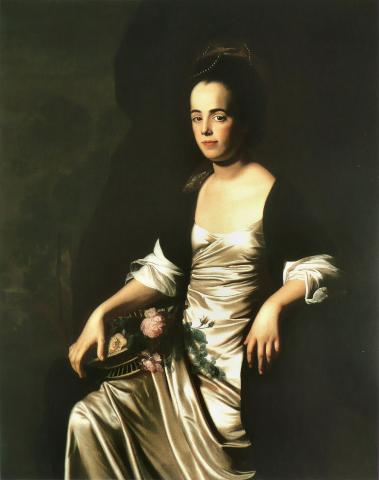
Quick Facts
Born: May 1, 1751, in Gloucester, Massachusetts
Died: June 9, 1820, in Natchez, Mississippi
Nationality: United States of America
Genres: Poetry, Drama, Theater
Works: A Rebus (1803); An Hypothesis (1808); Apology for an Epilogue (1790); Lines Written while Rocking a Cradle (1802); Birthday Invitation (1803); Lines Occasioned by the Death of an Infant (1790) Lines, Inscribed To An Amiable, And Affectionate Mother (1803)
Judith Sargent Stevens Murray (born May 1, 1751, in Gloucester, Massachusetts - died June 9, 1820, in Natchez, Mississippi) was an early American author and women’s rights advocate. She was one of the first American advocates of the idea of gender equality, arguing that women, like men, have the capacity for intellectual achievement and should be able to attain economic independence. Among many other influential works, her essay “On the Equality of the Sexes” paved the way for new thoughts and ideas that were further developed by other feminist authors of the century.
Judith Sargent Murray was a feminist pioneer. She was one of the first to publicly advocate for women’s equality in the new nation and to champion their education and economic independence. Her ideas were also taken up by the post-revolutionary “Republican Motherhood” movement, which advocated for women’s education in the name of passing on civic values to future generations.
She wrote about a hundred essays, including “On the Equality of the Sexes”, published in 1790, as well as numerous poems and two plays. She also wrote under pseudonyms such as “Constantia,” “The Reaper,” “Honora Martesia,” “The Gleaner,” and “Mr. Vigilius.” She adopted this male pen name to circumvent prejudices against her work. The Gleaner, a major three-volume work comprising essays and plays published in 1798, established her as a leading author and intellectual. In addition to feminist demands, these essays also address the values of the new republic (citizenship, philanthropy), universalism, and denounce war and violence of all kinds.
In one of her early essays, Desultory Thoughts upon the Utility of Encouraging a Degree of Self-Complacency, Especially in Female Bosoms, she articulates her feminist ideals. She lays the groundwork for future essays on women: “I would like, from the dawn of reason, to address [my daughter] as a rational being and protect [my daughters] from low self-esteem by every means.”
Some of her poems and essays were published in the Boston periodical “Gentlemen and Ladies Town and Country” in 1784.
At the age of twenty-three, she began compiling her correspondence with the aim of leaving a historical record for future generations. These collections of letters—twenty volumes in total—were discovered in 1984 by Gordon Gibson and published on microfilm by the Mississippi Department of Archives and History, where the original volumes are housed. Containing approximately 2,500 letters, these archives constitute one of the few collections of writings by women from this period of American history.