
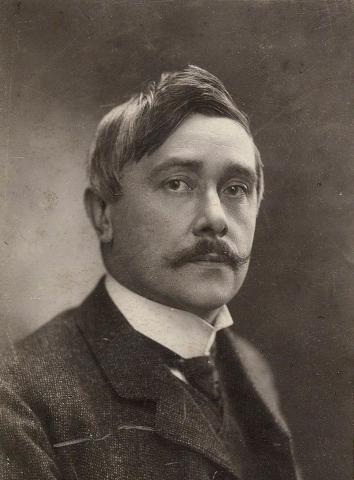
Quick Facts
Born: 29 August 1862 in Ghent (Belgium)
Died: 6 May 1949 in Nice (France)
Nationality: Belgium
Works: The Treasury of the Humble (1896), The Life of the Bees (1901), The Intelligence of Flowers (1907), Wisdom and Destiny (1898), The Buried Temple (1902), The Great Secret (1921)
Maurice Maeterlinck (by his real name Maurice Polydore Marie Bernard Maeterlinck), born on 29 August 1862 in Ghent (Belgium) and died on 6 May 1949 in Nice (France), is a French-speaking Belgian poet and writer who was a major figure in symbolism. He was awarded the Nobel Prize in Literature in 1911 “in recognition of all his writings and his many literary activities, and mainly from his dramatic works, which are distinguished by a wealth of imagination and by a poetic fantasy that reveals, sometimes under the veil of a fairy tale, a deep inspiration, while mysteriously appealing to the feelings of the reader and stimulating his imagination. “
Born into a Flemish, Catholic, conservative and francophone bourgeois family in Ghent, Maeterlinck was the eldest of three children. He spent an easy childhood between Ghent and the family property of Oostakker, influenced by the Flemish landscapes that will mark his imagination by their lights, mists, and channels.
He studied at Sainte-Barbe Jesuit College in Ghent and then studied law at the University of Ghent. Admitted to the bar in 1886, he briefly practiced as a lawyer but quickly abandoned the path of justice, feeling ill-suited to the profession. In 1885, he published his first Parnassian-inspired poems in the newspaper La Jeune Belgique. And after a stay in Paris between 1885 and 1886, he met Villiers de l'Isle-Adam (who influenced him profoundly), and from then on began to frequent the symbolist circles where he discovered Stéphane Mallarmé. Later he also became interested in Flemish mysticism, particularly “Ruysbroeck the Admirable,” which he translated, and German idealism (Hegel, Schopenhauer), as well as Novalis and Jena's romanticism.
In 1889, he finally published his first collection of poems, “Serres chaudes,” an emblematic collection of suffocating plant images, depersonalization, Mallarmean suggestions, a poetry mainly with a free verse that would later influence the entire poetic work of Apollinaire. This book will be followed by his first play “The Princess Maleine.” The latter was a resounding success thanks mainly to an enthusiastic article published by Octave Mirbeau in Le Figaro in August 1890, which made it famous overnight.
In 1895, Maeterlink met the actress and singer Georgette Leblanc (sister of Maurice Leblanc, the famous creator of Arsène Lupin), with whom he lived together for more than twenty years (during this period they conducted a remarkable literary salon in Paris). But their relationship ended in 1918 when his relationship with young actress Renée Dahon, whom he met in 1911, was discovered, and he married in 1919. The couple moved to the restored abbey of Saint-Wandrille in Normandy, then to the Palais Orlamonde (or Villa Orlamonde) in Nice, which Maeterlink had built but they had no children.
Maeterlinck, who lived mainly in France from the late 1890s, was awarded the Nobel Prize in 1911, and also became a count in 1932 (anoblated by King Albert I of Belgium). During the Second World War, he went into exile in the United States (1939-1947). Back in Nice, he published “Bulles bleues” (1948), which recounts most of his childhood memories. The Académie française awarded him the Prix de la langue française in 1948. He died a year later of a heart attack on 6 May 1949 in Nice.
Maeterlinck's work embodied in all its aspects the symbolist theater: its mysterious atmospheres, its fatalism, but above all the obsessive presence of death, elliptical dialogues, silence and suggestion rather than the traditional dramatic action. His theater is often called “static” or “theater of the soul.” He explores the tragic everyday, the destiny and the invisible.
Maeterlinck is above all the man who dared to stage the invisible: the deaf anxiety, the mystery of destiny, the secret communion between the human soul and the forces of nature. Its symbolism is not a decoration; it is a way of feeling the world, of suggesting what ordinary words cannot grasp. Even today, when we read Pelléas, when we open The Life of the Bees, we feel this strange vibration, as if a wind from Flanders crossed the pages and reminded us that, behind daily life, there are greater, quieter, and infinitely poetic forces. A Flemish who wrote in French one of the most singular pages of the European soul.
Maeterlinck translated Ruysbroeck, Novalis, and adapted Shakespeare (Macbeth) and John Ford. His work embodies the transition from naturalism to symbolism and influences modern theater (from Maeterlinck to Beckett via Strindberg or the theater of the absurd). His work mixes mysticism, initial pessimism and then optimism, fascination with nature and destiny. If its popularity declined after the Nobel, Pelléas and Mélisande and L'Oiseau bleu remain classics. He is the only Belgian to have received the Nobel Prize in Literature.
His poetic style, dreamlike atmospheres and vision of a universe governed by invisible forces continue to inspire literature, music and theater. It rests in Nice, and its Palais Orlamonde testifies to its taste for a refined life.