
Quick Facts
Born: December 10, 1830 in Amherst, Massachusetts
Died: May 15, 1886 in Amherst, Massachusetts
Nationality: United States
Genres: Romanticism, Realism
Works: "Hope" is the thing with feathers (1891), The Gorgeous Nothings (2012), Because I could not stop for Death (1890)
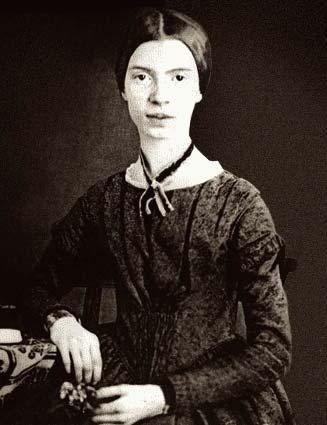
Emily Dickinson, born on December 10, 1830 in Amherst, Massachusetts and died on May 15, 1886 in the same city, was an American poet. After many incomplete studies and, it seems, some disappointment smelt mental, she isolates herself in her Amherst's native home (Massachusetts), keeping only one for any link with the external world correspondence with some closest friends, as the Reverend C. Wadsworth, her spiritual adviser, or literary criticism T.W. Higginson. Dead with little or no publication, she left some 1,500 short poems (668 of which would not be published until 1945), mostly clutched on small pieces of paper. These are fresh and naive notes on her daily life, her garden, the birds, the flowers, the cycle of the seasons, but also poignant reflections on love, death and the mysteries of the Hereafter. Prone to paradox, it can be both light and deep, spiritual and pathetic. Sheltered from any literary influence, she escapes the convention and the poetic cliché. By her elliptical style and the flexibility of its metric, she joins the English metaphysical poets. By precise and bold metaphors, which give a concrete expression to emotion or abstraction, she announces the imagists who discovered her and made her known around 1920.
Like a secret garden hidden within the walls of her home, Emily Dickinson's lyrical world spans vast horizons, a universe of words that reaches far beyond the confines of her life. Like a master craftsman of the mind, Emily Dickinson's limited world of experience didn't hold her back; it fueled her creativity. Through the power of her imagination, she transformed the small, familiar world around her into a vast universe of possibilities. Her life's experiences became the canvas for her literary masterpieces.
To make a prairie it takes a clover and one bee,
One clover, and a bee,
And revery.
The revery alone will do,
If bees are few.
In the literary world of her time, Emily Dickinson was a true kindred spirit to Walt Whitman—an “epigrammatic Walt Whitman,” as they called her. And because of her deep connection to the English metaphysical poets, especially George Herbert, she was affectionately known as a “Puritan metaphysical poet”—a woman of wisdom and wonder who saw beyond the ordinary. Like puzzles of words, critics' descriptions of Emily Dickinson—whether she was “a private poet, who wrote indefatigably, as other women cook or knit” or “a volcano erupting in a block of ice”—reveal the challenge of pinning her down to a single poetic school.
She was a force of nature, a mystery wrapped in verse, defying easy labels. Like threads woven through her words, her favorite themes are nature, love, death and the anticipation of death, immortality, and also renunciation and the transcendence of time—stories of the eternal amidst the fleeting. In the lines above, the dreamlike birth of a prairie, woven from clover and bee, remains anchored in the here and now. But in the poem 'Indian Summer,' a familiar seasonal wonder becomes a gateway to eternity, a fleeting moment that connects us to the timeless. It's like a whisper of the ages, a little piece of magic caught in the air. Like a secret door opening to a sacred mystery, the invocation of the sacrament of the Holy Communion (“Oh sacrament of summer days, Oh, last communion of the haze”) in this poem transforms the fleeting phenomenon of late summer into a profound connection. After the lyrical self's failed attempt to find meaning (“Oh, fraud”), the season becomes a silent witness to the profound significance of Jesus Christ's sacrifice, it's a story of loss, of redemption, of the very essence of life. Like a tragic tale, the New Testament's end once seemed to the disciples a great deception, a heartbreak, and destruction. But now, like a shimmering dawn, it takes on a new meaning—symbolic, uplifting. As Hans Combecher unveils in his interpretation of this poem, destruction itself becomes redemption, the fall a direct path to ascension. It's a story of loss that leads to liberation, of ruin that paves the way for glory. Like a golden halo, the Indian summer season bathes the 'dying nature' in light, a radiant metaphor for Christ's act of redemption—an autumnal miracle of hope and renewal. Like a time capsule, the poem remains anchored in the present, yet its heart reaches out to both the echoes of the past and the promises of the future—an eternal dance between yesterday, today, and tomorrow. Like a whisper of the past, the memory of summer lingers in the heart of nature's fading, transforming decay into a promise of an eternally glorious future—an infinite promise that, in the fleeting moment of transience, awakens all our senses.
In Emily Dickinson's poetry, the separation of the sacrament from the person and authority of Christ, as enacted in the poem, is a window into time—revealing not just a distinctly Puritan influence but also the quintessential American modern break from those dogmas. Like a key unlocking a door, Dickinson's poem transforms the figure of Christ into a “symbol of transcendence,” pointing to a reality beyond our own. It's a story of faith, of connection, and of a soul finding its way. In this way, Indian Summer becomes a living example of a fascinating dichotomy: the enduring influence of Puritan-Calvinist faith and thought, and the simultaneous secularization of its Christian core—an American trait that often leaves Europeans wide-eyed in wonder. It's a story of faith, change, and the very essence of the American spirit. Like a whisper of the seasons, the phenomena of late summer—its fading promise, the sense of what is yet unseen, and the recognition of the familiar within the unfamiliar—resonate through Dickinson's other poems, such as “As Imperceptibly As Grief,” becoming a tapestry of time and emotion. Like an artist unveiling a masterpiece, Dickinson paints a picture of lived reality here. Within the apparent stillness of its appearances lies the secret of movement, of what imperceptibly fades away. It's a dance of the incomprehensible, of the indescribable, a process hinted at by the poem's title, brought to life through her words.
Dickinson certainly employs traditional meters, especially the common meter with alternating 8 and 6 syllables, reminiscent of hymns and ballads, or the common particular meter (8, 8, 6, 8, 8, 6), which never sounds monotonous because she varies it subtly or even explicitly. She also uses the sevens and sixes (7, 6, 7, 6), the long meter (8, 8, 8, 8), and others. However, metrical breaks or incomplete rhymes often signal thematic breaks or contradictions. The break with classical forms of poetry, the numerous dashes with otherwise absent punctuation, considerable liberties with sentence structure, missing verbs, abstract astronomical terms, inconsistencies in the choice of personal pronouns, and numerous unfinished thoughts (an elliptical syntax) complicate the interpretation of her lyrical work.