
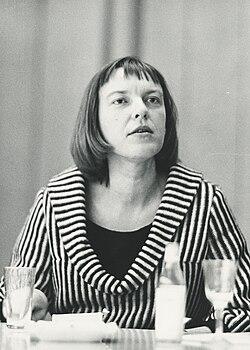
Quick Facts
Born: 25 June 1926, in Klagenfurt
Died: 17 Oct. 1973, in Rome, Italy
Nationality: Austria
Genres: Poetry
Works: In the Storm of Roses: Selected Poems (1986); Paths to the Lake (1989); Songs in Flight: The Collected Poems of I. B. (1994)
Ingeborg Bachmann was an Austrian poet, dramatist, and novelist, born 25 June 1926, in Klagenfurt, and died in 17 Oct. 1973, in Rome, Italy. He grew up in Carinthia. After World War II she studied philosophy at the universities of Innsbruck, Graz. and finally Vienna, where in 1950 she completed a doctoral dissertation on the philosopher Martin Heidegger (1889-1976). She worked for the Austrian radio until 1953, when she became a full-time writer, and later lived in several cities, including Rome, Munich, Zurich, and Berlin. In 1959-60 she lectured on poetry at the University of Frankfurt. Among the literary awards she received were the Group 47 Prize ( 1953), the City of Bremen Prize (1957), and the Georg Büchner Prize (1964).
Bachmann's verse is deeply indebted to a number of poetic traditions. similarities to many poets and literary movements, including Klopstock (1724-1903) and Rilke, classical antiquity and Surrealism, have been noted. Nonetheless, her poetic voice is both modem and distinctive. A somber mood pervades most of her lyrics and an intensely personal mode ot expression is typicaly present. Unresolved existential dread can often be felt. The inevitability of guilt and human frailty, the difficulty of finding happiness in love, the inadequacy of language and the failure of communication, and, less frequently, the bleak political situation contribute to the dark vision of her poetry. Literary allusions, mythology, current events, and subjective exclamations are interwoven in a verse characterized by powerful and distinctive images, which often assume the quality of private ciphers. Snow and ice, suggesting the sterility of social relationships and the absence of love, are images of considerable importance.
With a single exception, the poems of Die gestured Zeite (1953; borrowed time) are written in free verse, and in general both the poems and the individual lines are rather long and possess a hymnic quality. The poetry of Anrufung des Grofien Bdren (1956; conjuration of the Great Bear) is in most respects similar. Rhyme, however, is used more frequently, and the pervasive elegiac tone is quite personnel. Semipolitical poems appear infrequently, but one exceptional is the famous little poem, in which the constellation Ursa Major is represented as a circus bear with the power to destroy the world at any time. In the the equally famous but more typical "Nebelland" (fogland), the monologue of a forsaken lovenia manuis pervaded by winter imagery. The concluding cycle of fifteen "Leader auk der Fluht" (songs in flight) develops the themes of the transience and painfulness of love. The beginning of the short final poem continues the elegiac tone, but in an unusual reversal B. ends the collection with an affirmation of the enduring nature of poetry. This conclusion, strongly reminiscent of Rilke, runs counter to the mood of the collection as a whole, and the transcendence suggested in it rarely appears in B.'s later works.
Malina (1971), one of Bachmann's last works, is a lyrical novel, an introspective love story with autobiographical elements. The title of the introductory section, "Vienna; Today," suggests a realistic setting, as do two characters sketched there: the nameless first-person narrator, a well-traveled woman writer who was born in Klagenfurt, and Ivan, her lover, a man in his thirties with two children and a job. As the love relationship deteriorates, the focus shifts from external reality to the troubled mind of the narrator. Haunted by nightmarish dreams, she loses contact with the world and establishes a relationship with Malina, a male alter ego, in which she loses her own identity. Her plans to write a book are abandoned, and at the end she is "murdered" by Malina. The murder is not to be taken literally, but as the representation of the change in the narrator's personality, the result of the traumatic end of her relationship with Ivan. The themes—the inadequency of languages, the problematic nature of love and of life itself—are familiar from B.'s lyrics. The style of the book is subjective and lyrical, and plot elements are more often suggested or intimated than actually narrated.
Her most successful radio play, Der gute Gott von Manhattan (1958; The Good God of Manhattan, sound recording, 1990), which like most of her other works is concerned with the tension between an ideal and reality, today seems naive and dated. Her poetry and fiction, however, continue to receive high acclaim, and she is recognized as one of Austria' s most accomplished postwar writers.