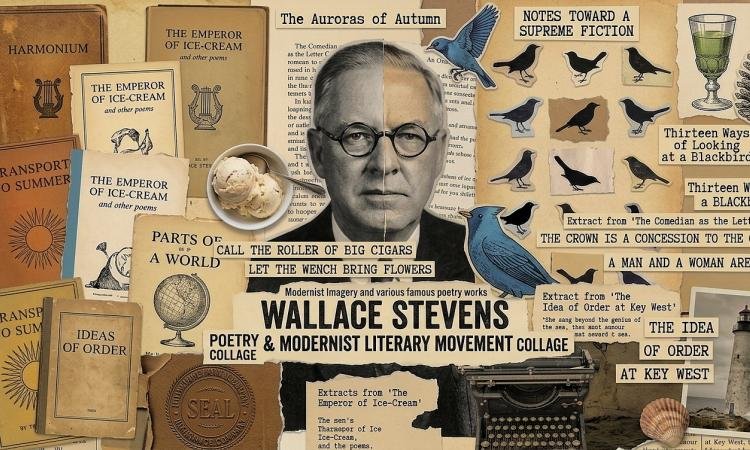
Although he appeared as a poet relatively late in his career, the author left a considerable work and is considered one of the most important American poets of the twentieth century, whose influence remains intact. At the same time, his theory of poetry, exhibited in many poetry poems as well as in essays and aphorisms - the latter collected in "The Necessary Angel," 1951, and "Opus Posthumous," 1957 - exerted an almost invaluable influence on American literary critics and theorists. Stevens' language and terminology, through a large number of direct borrowings, barely identifiable as quotations, have become an essential component of American critical language (for example, in Harold Bloom's work). Thus, whether we deplore it or not, the knowledge of Stevens' contexts is tacitly accepted, even if they require a reinterpretation anyway.
Despite her first poems published in the student magazine.
The Harvard Advocate, Stevens experienced a late ascent, only gaining fame in 1923 with his collection of poetry Harmonium. The fact that this book initially remained in the shadow of The Vain Earth of T. S. Eliot, published in 1922, is probably due to Stevens' lack of affiliation to a particular group or school, its lack of close links with a publishing house and absence - unlike Ezra Pound, the patron of Eliot - an active protector, even if he had published poems in isolation since 1914, notably in Poetry, Harriet Monroe's prestigious poetry review. Among these publications is (in an abridged version) his most famous poem, "Sunday Morning," which has since been frequently anthologized and translated internationally. This brilliant tour de force gave the impression that a poet mature and sure of him had emerged from nowhere. Stevens's profession, his jealously preserved private life in a provincial capital and his refusal to exchange a comfortable bourgeois existence for a life as a miserable artist in "purple granaries," for example in Paris, helped to fuel this myth. "Sunday Morning," however, clearly testifies to Stevens's precise and profound study of American (Ralph Waldo Emerson, Walt Whitman) and English (John Milton) poetic traditions, particularly English romanticism (Samuel Taylor Coleridge, John Keats, Percy Bysshe Shelley, William Worley dsworth), as well as French symbolists and impressionists (Stéphane Mallarmé, Paul Valéry, Jules Laforgue).
As Bloom pointed out, Stevens began his reflection where Keats had already done, that is, after the "death of the gods," with the world emptied out as the starting postulate where the self and its creative forces must be activated to pave the way for new beliefs. At the same time, "Sunday Morning" is a poem of personal crisis, in which Stevens, through his protagonist (who can certainly be considered a muse), breathes new life into his poetic ambitions of youth, almost forgotten, in the midst of his existence. It is a rebirth (non-Christian) through an act of will, that is to say, to see the world with a new eye - in its "first idea," its "first jet" - with a clear look, and to recognize the inevitable death and the immutable change that every moment brings as the "mother of beauty." This program announces a poetry that renounces sentimentality and celebrates ex negativo beauty in its ambivalence conditioned by fugacity - a poetry of meditative thought in which poetic language is understood as an instrument to discover what can "suffice" in the face of the emptiness and destruction of the world, as it is said later in the poem "De la poésie moderne."
For Stevens' contemporaries, however, the term "modern" initially seemed to refer less to his poetry than to that of Eliot, who also made a freezing observation of the world's devastation. The first readers did not understand that Stevens' Harmonium shared, or even presupposed, this observation, while proposing a remedy. Thus, Stevens' texts were perceived as the elucubrations of a hedonist of the end of Romanticism, whose great mastery of an often artificial language, for always precise, was recognized, but whose contemporary relevance remained unnoticed. A short poem such as "The Snow Man" testifies both to his linguistic virtuosity and to his method of situational empathy, based on imagination, to the extreme reduction of the self in the face of negative reality:
The Snow Man
One must have a mind of winter
To regard the frost and the boughs
Of the pine-trees crusted with snow;
And have been cold a long time
To behold the junipers shagged with ice,
The spruces rough in the distant glitter
Of the January sun; and not to think
Of any misery in the sound of the wind,
In the sound of a few leaves,
Which is the sound of the land
Full of the same wind
That is blowing in the same bare place
For the listener, who listens in the snow,
And, nothing himself, beholds
Nothing that is not there and the nothing that is.
This poem illustrates two important aspects of Stevens' poetry: In terms of content, it relates to the concept of the seasonal cycle of imagination, which interacts with reality in different ways depending on the epoch, and thus transforms itself. This seasonal rhythm - at Stevens and other American poets, such as Elizabeth Bishop - also finds a geographical analogy: the tension between North and South is perceptible in Stevens' poems and, given her residence in the North and her stays in Florida, she also has autobiographical sources. The poems "Sea Surface Full of Clouds," "Farewell to Florida" and "Arrival at the Waldorf" are notable examples. Moreover, "The Snow Man," with his reflection on the function of the winter imagination, is a good example of how Stevens opposes what John Ruskin called "pathetic sophism," that is, the emotional sophism of anthropomorphizing nature.
Although the non-anthropomorphic thinking of the author - at least in its winter and reductive aspect - remains relatively rare in the effervescence and profusion of Southern landscapes and themes present in Harmonium, this dimension of imagination takes on increasing importance in the next three collections of poetry, published rapidly after the reprint of the first volume (1931). "Let being be the end of appearance," he says programmatically in Harmonium's poem "The Emperor of Ice Cream." This verse has a twofold meaning for Stevens' poems written in the years following the Great Depression of 1929 and during the rise of social unrest in the United States: on the one hand, he regarded the poetic imagination as a force that thwarted the destructive external reality through the creation of fiction. Imagination, as Stevens asserted in his 1942 essay, "The Noble Cavalier and the Sound of Words," "is an inner force that protects us from an outer force." Poetry therefore has the task of projecting an order, in the sense of a conceptual and linguistic conception of the possible being. On the other hand, it must confront reality in order to remain a living force. Thirdly, imagination also has a "destructive" function, dissolving established structures before a new creation can take place. In this context Stevens spoke (using a term forged by Simone Weil) of "decree."
Ideas of order (1935), the second volume of Stevens, as well as the collection of 1937 The Man with the Blue Guitar, explore the interaction between reality and imagination in a much colder, less colourful, but more abstract style.
These volumes work towards the conception of a poetically understood reality. Key verses from the poem "The Idea of Order at Key West" dating from this period, thus evoke a poetic song with "more ghost demarcations, more sharp sounds" - a conception that implied a project of linguistic revitalization reminiscent, by its approach, of Whitman and Mallarmé.
The next stage of this project is represented by the poems of the 1942 collection, "Parts of a World". In "The Poems of Our Climate" (1987), for example, another facet of the linguistic theme of "Key West" is highlighted:
The imperfect is our paradise.
Note that, in this bitterness, delight,
Since the imperfect is so hot in us,
Lies in flawed words and stubborn sounds.
This desire for imperfect everyday language must be perceived positively, for it corresponds to and expresses human imperfection. These verses are the dialectical counterpoint to the summer and magical sounds of "Key West." By that time World War II had broken out, but despite his claimed closeness to harsh reality, Stevens did not become a supporter of "committed literature." Although he felt compelled to adapt the combative imagination to personify the hero into a contemporary figure, this attempt degenerated into a somewhat embarrassing pathetic, as in the poem "Examination of the Hero in Time of War." As had already happened - on the occasion of the publication in 1936 of the collection "Le Trèfle du Owu" which was never republished in this form - such concessions to the spirit of the time earned him strong criticism. In this respect Stevens is comparable to Gottfried Benn, who insisted on the writing of "autonomies," following only the poetic "wandering freedom constrained by necessity," which, for Stevens, was also of an exclusively intellectual nature.
This "American" necessity - Stevens refers here to a central concept of Emerson - gave rise to the great project of a poetic and linguistic utopia in the long poem Notes Toward a Supreme Fiction, 1942 (Notes 68 on a supreme fiction). This long poem is his poetic response to the situation of the Second World War, since it was published separately in 1942 before being incorporated into the collection Transport to Summer, published in 1947. Stevens develops tracks for a project (never completed) aiming to shape poetically a "world" (mundo) of the imagination, whose components - as the titles of the three parts of the poem testify - reflection ("It must be abstract"), change ("It must change") and aesthetic pleasure ("He must give pleasure") had already been sketched by individual poems from earlier collections. The concept of this global poetic conception of the world is already contained in the first title of Harmonium, rejected by the publisher: "The Great Poem: Preliminary Mints" (The Great Poem: Preliminary Mints).
Stevens developed his concept further in this long non-epic poem, in a meditative way, in a long and paratactic structured flow of consciousness. The contradictory reflections on the nature of an effective contemporary poetic language, initiated in "Key West" and "The Poems of Our Climate," found a resolution in Notes, with the requirement to merge "the Latin of the imagination with lingua franca and jocundissima," the universally understandable and supremely pleasant language. Poetic language, which, as a "particular language," can express the singular potential of the whole, is, according to Stevens himself, a compound. This intuition - and the postulate of permanent change - later proved fruitful in eclectic linguistic mergers, such as those found in John Ashbery's long poems.
If "Notes" and "Credences of Summer" - the latter being also a poem on the fulfillment of a utopian counter-proposition erected as an object of faith - are the fruit of the summer imagination of "Transport to Summer", the last two collections of the author again express his winter imagination, constrained by necessity. The eponymous poem of the collection, The Auroras of Autumn, 1950, deserves special mention; it is perhaps the most successful poem of the old Stevens. Here - as in "An Ordinary Evening in New Haven", the second long poem of the collection - we find, in an extreme sobriety, even a certain aridity, of language, a thematic inventory of what has been accomplished, a testing and an evaluation of previous thinking positions. With ruthless self-criticism, this poignant farewell poem returns the ball to the pious vows and illusions of past projects. In an almost polar solitude and a "clairvoyance," the old poet, with great courage in the face of his imminent end, nevertheless affirms his confidence in the feasibility of "supreme fiction", in accordance with his earlier precept that it is vital to believe in a fiction while knowing that it is not true.
The following poems, extracted from the collection The Rock, originally published in Collected Poems (which won the Pulitzer Prize in 1955) in 1954 and which conclude this volume, develop this newly acquired austerity while embracing an unprecedented intimacy between the poet and his characters, as if he added the section "It Must Be Human," initially planned as the fourth part of "Notes." For, without a doubt, the "world" of imagination, the "supreme fiction," is nothing "until it is contained in one human being." In this sense, for Stevens himself, as he wrote, "poetry is life".
The poem is the cry of its occasion,
Part of the res itself and not about it.
The poet speaks the poem as it is,
Not as it was: part of the reverberation
Of a windy night as it is, when the marble statues
Are like newspapers blown by the wind. He speaks
These verses from An Ordinary Evening in New Haven convey the message of the possible immediacy of the poem. As an expression of its context, it transmits - like the cry of a newborn - life as a moment that perpetuates itself in a continuous change and, at the same time, requires the erasure of past moments in order to continue to live. “Words of the world are the life of the world” the poem continues. Everyday language, meditative contemplation of one object, substitution of one perspective by another, the withdrawal of the poet's person behind language - all elements of Stevens' poetry without which contemporary American poetry is inconceivable, so much so that stressing the influence of Stevens on this or that poet has become almost a critical commonplace. Stevens' project of poetic acquisition of knowledge in and with language has become an essential component of contemporary poetic projects aimed at freeing itself from the language cacophony that prevails in the information society "about something," hence the thing itself threatens to escape us.