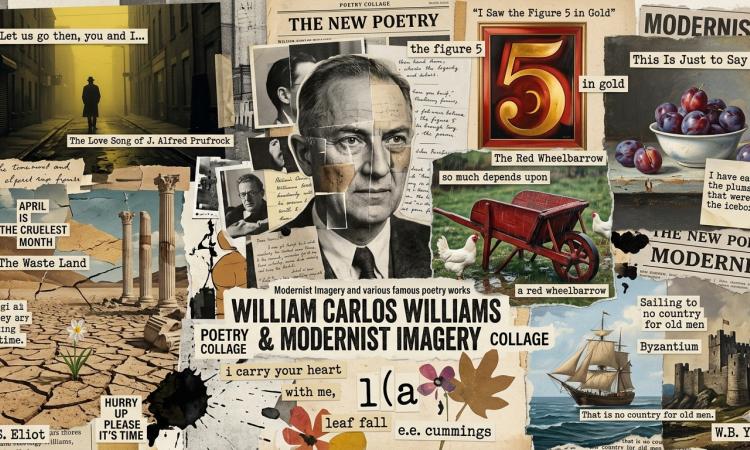
William Carlos William is considered one of the most influential poets in the United States. Modernism. Sometimes his late work is also attributed to postmodernism. His literary reputation grew steadily during his lifetime, but only slowly, and it was only with the posthumous Pulitzer Prize for the collection of poetry Pictures from Brueghel (1962) that his prominent place in the canon of American poetry was finally confirmed. After an initial phase of reception (until about 1960), which highlighted empiricism, pragmatic frankness and the radical and indifferent nature of his style, he is now also perceived as an exceptional poet and theoretician thanks to his linguistic and poetic expertise. His decision to spend his entire life in an industrial city in New Jersey, just outside New York, is not only of biographical interest, but also testifies to his conviction, which he shared with philosopher John Dewey, among other things: “The only universal is in the local.”
The lyrical work, without the long poem Paterson (1946-1958), has been available in two volumes since 1986. Williams himself had not prepared a complete edition of his works during his lifetime. In addition to the individual volumes of poetry published at intervals of two to six years, he published collections and anthologies, each however remaining limited to a certain creative period and gathering mainly his works already published in magazines. Throughout his life, his poetic activity was complemented by the writing of essays, dramas and prose works of all kinds: translations, historical portraits, novels and texts inspired by autobiography. The middle and end of the period of his work is closely related to the New York publisher and poet John Laughlin, who founded the literary publisher New Directions in 1936 and engaged Williams as one of the first authors on the advice of their common friend Ezra Pound.
Williams's early poems, between 1909 and 1913, were still mainly based on nineteenth-century Victorian poetry, although early attempts to find a new poetic diction beyond the compulsion of rhyme and traditional forms of strophes were already recognizable. Particularly remarkable is the longer poem The Wanderer. A rococo study, 1913, since Williams experimented with the form of a longer text, rhythmic but without rhymes, in the style of Walt Whitman, and thus found an original visual language for the revolutionary aesthetics of modernism. The Wanderer is the “young soul” poet initiated as a poet by his “muse,” an old ugly and witch grandmother, and by the dirty waters of the Passaic River, and who takes up his new wanderings. Williams breaks radically with the conventions of the traditional idyll, where his iconoclasm is neither cynical nor pessimistic, but in his belief in the epistemological power of aesthetic experience he welcomes the new where he finds it.
Beginning in 1914, he wrote poems considered typical of Williams: short verses, irregularly long strophes, concise and often incomprehensible descriptions of situations, often with direct quotations from everyday language, and finally with laconic commentaries on lyric ego. A perfect example is the poem “Pastoral,” in which the poet describes a scene of his environment, seemingly naive and purely observant, which appears as an “urban” or “suburban” pastoral idyll. At a second glance, however, and with particular attention to linguistic ambiguity, the poem also proves to be a philosophical reflection on experience and its meaning in the creative process.
With the poetry collections Al Que Quiere, 1917, and Sour Grapes, 1921, Williams made his literary breakthrough, first in the circles of the New York avant-garde. He was also influenced by visual artists, and his texts in turn became a source of inspiration for painters, such as Charles Demuth's The Great Figure, 1928, one of the first Pop Art paintings. Spring and All, 1923, a hybrid collection combining poems and poetic reflections, was printed in Dijon (France) and also received some attention in Paris. If the theoretical intertexts of this volume remained difficult to access until the complete edition of 1986, certain individual poems have become very well known thanks to their successive anthology in other editions, such as “on the road to the contagious hospital,” “the rose is obsolete” or “so much depends/on a red wheel/tumulus”.
The following volumes consolidated Williams's place in American literature and ensured his influence on the next generation of poets, such as Denise Levertov, Allan Ginsberg, Charles Olson, Robert Creeley, Frank O'Hara and John Ashbery. Realistic and detailed observations and direct quotations of the spoken language of daily life remained characteristic of him, although previously even friendly literary criticism had repeatedly overlooked the fact that this should not be confused with the renunciation of symbolism and controlled ambiguity. His maxim “No ideas but in things” has also long been misinterpreted as a rejection of “ideas” or “reflection.” Williams, however, considered this sentence intrinsically linked to the neo-Aristotelian motto › Nihil in intellectu quod non prius in sensu ‹ (› Nothing is in the intellect that was not previously in the senses ‹) and thus defined intellectual reflection as a process that must begin with immediate experience and perceived perception, but does not end there. In another central poetic image, he compared a poem to a machine, the most important feature of which is its functionality: without superfluous ornaments or sentimental elements, with components that work harmoniously with each other, be it vials or words. Through his work as a general practitioner and obstetrician, he also had an insight into the reality of the lives of socially disadvantaged social classes. At the same time, its fundamentally humanitarian attitude has remained free from moral evaluation and cannot be clearly classified politically. Sexuality, birth, sickness and death are accepted and presented as part of life in a way totally without sentimentalism, shyness or pudeurism. The relationship of his poems with these existential extremes is not only realistic, but often suggestive and psychologizing, which at the same time addresses the largely troubled management of such taboos in modern society. For example, “Choral: the Pink Church” is a vision influenced by surrealism that denounces institutional constraints. Ironically, at the time of “red fear” (that is, the fear of Soviet infiltration), this poem was misunderstood as a hymn of praise to communism and prevented the author from being appointed as a poetic councillor at the Library of Congress in Washington.
With the publication of Desert Music in 1954, Williams developed a new meter with flexible accentuation and three-verse strophes (a “triadic line”). The accentuation is supposed to follow the breathing, thus reproducing an organic structure. “The Descent” (1954) is a remarkable example of this form, as is the strange love poem “Asphodel, That Greeny Flower” (1955), dedicated to his long-time wife, Florence. The poem addresses imminent death and the question of how love can challenge it. Literature plays a major role, as evidenced by this verse: “It is difficult/to receive news by poems/yet men die miserably every day/by lack/of what is there. Williams' last completed volume of poetry, Pictures from Brueghel, 1962, which he wrote after several brushes, contains texts in the tradition of ekphrase (the poetic description of the images) and traces the arc until his year of study in Europe, when he had seen several of these paintings in the original in Vienna in 1923. These latter poems are both condensed reflections on the productive power of poetry, even in the face of death, and reveal Williams at the top of his poetic career as a stylistic and thematic innovator of American poetry.